Learn more about security ratings to understand how you can use these measurements to improve overall security performance. In this guide, we’ll look more closely at the security rating methodology to determine what to focus on first, which changes are most impactful, and how to track improvements.
<H2> What Are Security Ratings?
So what is a security rating? Conceptually, security ratings are data-driven, dynamic measurements that allow you to evaluate an organization’s cybersecurity performance.
Security ratings provide insights into first- and third-party security risks and serve as indicators for cybersecurity teams on security performance within their own organizations. They are also crucial for understanding the security posture of third-party organizations you work with.
As independent assessments of enterprise security, security ratings take into account data from both public and private sources, which are then analyzed using proprietary scoring methodologies. Typically, rating methodologies focus on an organization’s ongoing security execution in addition to point-in-time measurement of its risk exposure. Key aspects in calculating a security rating include data collection, observation, and analysis.
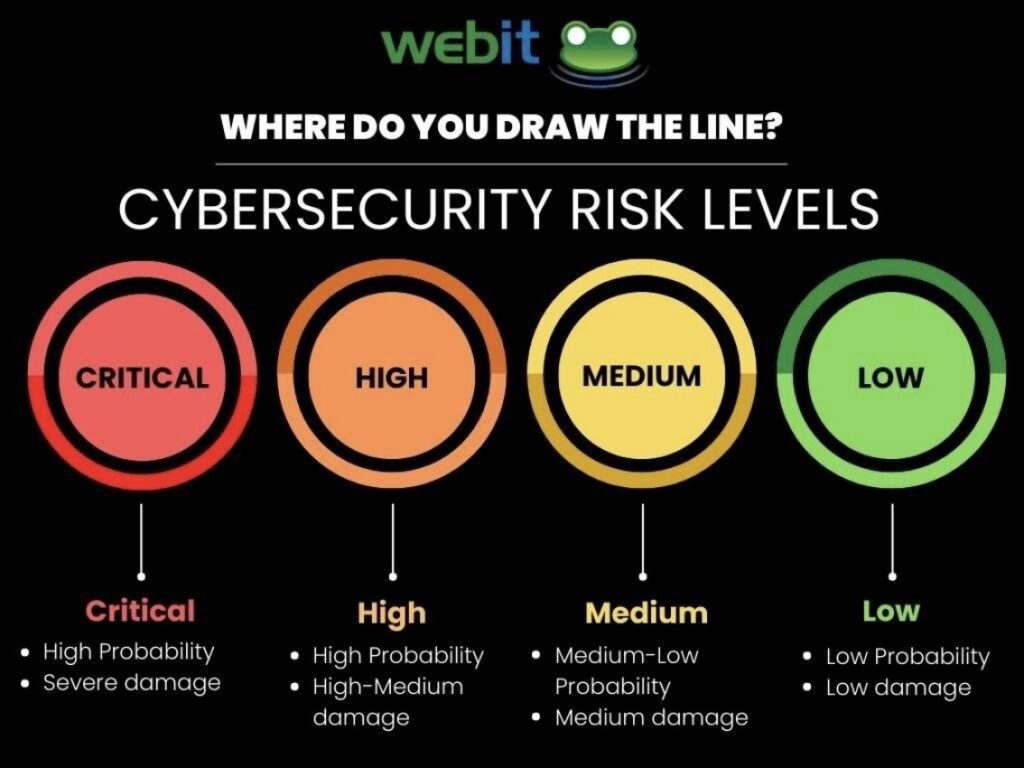
(інфографіка такого типу з текстом Critical: High Probability / High Damage || High: High Probability / High/Medium Damage || Medium: Medium/Low Probability / Medium Damage || Low: Low Probability / Low Damage)
<H3> What Security Ratings Measure
Security ratings providers consider various factors when determining an organization’s security rating. The most important aspects are:
- Cybersecurity Posture. This helps to assess an organization’s cybersecurity health over time. Providers use dynamic, continuous measurement methods to calculate the score.
- External Security. This helps evaluate the effectiveness of an organization’s security posture from the perspective of the external attack surface, specifically how the company’s security appears from the outside and what security issues and vulnerabilities threat actors might see.
- Performance. Here, the objects of interest are the security program and security control effectiveness. Thus, security ratings providers can better understand how well an organization protects its assets and infrastructure from cyber threats.
- Cyber Risk. An organization’s cyber risk assessment provides an overview of vulnerabilities that could lead to a data breach, as well as the effectiveness of security practices in mitigating these potential risks and threats.
- Third-Party Risk. This factor is key because it allows you to evaluate the security posture of third-party vendors your organization collaborates with and the cybersecurity risks and threats their solutions/platforms may pose.
<H3> The “Credit Score” Analogy (and Why It’s Not Perfect)
Security ratings and credit scores can sometimes seem similar because they are based on assessment and measurement. While a credit score measures financial reliability by analyzing credit history, debts, and payments, a security rating evaluates an organization’s security based on its practices, vulnerabilities, and incident response plans.
This analogy is theoretically feasible, as it provides a basic understanding of how security ratings work for people without a technical background. However, cybersecurity ratings are a slightly different concept. The security rating process focuses on technical vulnerabilities, which are more difficult to quantify than, for example, a credit rating, which is based on data with clear metrics. Furthermore, cybersecurity ratings use proprietary methodologies and have limits, meaning conclusions are often based on external scanning. Therefore, the analogy between security ratings and credit scores is not perfect, except perhaps to understand the general concept.
<H3> Why Businesses and Regulators Care
Security ratings provide insight into the security and reliability of an organization’s infrastructure and systems. For example, an A-rated organization will likely face no difficulties when it comes to audits or partnerships. At the same time, organizations with C/D ratings may not be attractive enough for business relationships. With an F rating, the chances of entering into a partnership are zero, and such an organization will likely face fines and restrictions from regulators if it doesn’t improve its situation.
For businesses and key stakeholders, security ratings can help in the following areas:
- Creating a third-party risk management program
- Transparency in cybersecurity matters to avoid fines and reputational damage
- Assessing the organization’s real and up-to-date security posture
- Finding a trusted partner
Regulators are interested in:
- Compliance with regulatory requirements
- Protection of customer data and finances
- Assessing systemic risks, especially in supply chains
<H2> Why Security Ratings Matter More Than Ever
Today, across industries, we are witnessing digital transformation, the globalization of services, and the emergence of new cybercriminal tactics. Furthermore, most companies rely on third-party vendor solutions/infrastructure, as building and maintaining their own systems is extremely expensive. Consequently, it’s common for a single provider to interact with data from multiple businesses through integrations. This makes such vendors attractive to attackers, as a successful hack could give them access to data from multiple organizations. For this reason, security ratings services are in demand, as they provide an overall assessment of an organization’s security and risk posture.
Furthermore, since security ratings provide an objective, trusted assessment of a company’s overall security performance, they influence decision-making. This is especially valuable for companies that offer their solutions, as a good or bad security rating helps determine cybersecurity needs and priorities. Thus, security ratings can help security teams:
- Implement continuous monitoring and a proactive approach to security practices to mitigate risks
- Demonstrate an understanding of risk posture and effective mitigation strategies, which are essential for stakeholders, board members, and regulators
Security ratings are important because they provide a trustworthy framework for security teams to ensure that their efforts and investments are aligned with goals and deliver results, while simultaneously facilitating cyber risk evaluation and a collaborative environment.
*CTA* Improve Your Security Performance And Track Improvements With Jappware. Leverage Our Expertise To Manage Cyber Risks And Achieve A High Security Rating.
<H2> How Security Ratings Are Calculated
Let’s look at how security ratings are calculated. The primary method here involves collecting externally observable information about the rated organization, which also includes configuration details and security event evidence. Three key considerations are used in the calculation process to determine the security rating:
- Observable Configuration Details. This provides information regarding an organization’s cybersecurity hygiene, including security headers for web applications, current software/libraries/plugins, patching of detectable vulnerabilities, system hardening and firewall practices, as well as TLS/SSL encryption configuration and management.
- Observations About General Security Configuration. This includes assessing indicators of an active security event, such as communication with known command-and-control servers, malware distribution, network scanning, and participation in distributed denial-of-service (DDoS) attacks.
- Cybersecurity Risk Ratings. Since not all observable configuration details and security events are equivalent to risk, defining a security rating also involves mapping observations to predefined risk vectors, organizing these vectors into thematic categories, and assigning weights to specific risk vector categories. An algorithm can then be used to measure the security rating of a particular organization.
It is important to note that security ratings must be frequently updated using the observable data for all rated organizations to remain responsive to changes over time.
<H2> Turning Security Scores into Actionable Steps
As a cybersecurity health metric, the security rating provides a clear overview that security teams can use to take action and make improvements. It encourages regular security/risk/vulnerability assessments and pentesting, and also helps maintain an accurate asset inventory, attack surface analysis, monitor third-party vendors, and conduct staff training.
Overall, a security rating is a standardized KPI that simplifies processes such as cyber risk management, monitoring, and security assessment. Developers and security teams can use the rating to strengthen overall security performance in the following ways:
<H3> Performance Monitoring
By using security rating platforms, organizations can benefit from a continuous picture of cyber performance, allowing them to identify and remediate risks faster and align security efforts with a cybersecurity maturity model. This enables them to move beyond periodic, manual, and compliance-based reviews, which often provide only a point-in-time snapshot of security performance.
<H3> Uncovering Risk
Hidden or undetected issues can pose a significant risk, expanding an attack surface. Security scoreboards help identify assets throughout a digital ecosystem, thus highlighting gaps in cybersecurity controls (e.g., misconfigurations, unpatched systems, vulnerabilities, etc.).
<H3> Industry Benchmarks Monitoring
Because risk posture and other security ratings take into account data from multiple sources, as well as thousands of organizations worldwide, security teams can benchmark their performance against competitors, providing clear context for their own ratings for company stakeholders.
<H3> Risk Visualization
Security dashboards help identify concentrated risk areas across business units, subsidiaries, mergers, acquisitions, and disparate geographies. This is especially valuable for stakeholders, helping improve and ensure high security performance across the organization at various levels.
<H3> Understandable Reporting
A security rating is an excellent methodology for clearly explaining risks and potential security issues without delving into complex technological discussions. This simplifies communication regarding the findings of a security risk assessment through easy-to-understand reports and figures presented in a business context.
More specifically, developers can use security scores to convert them into specific tasks with priorities and deadlines.
- The first step is to prioritize threats. It’s important to identify critical and high-priority issues that require immediate resolution. It’s also crucial to focus on publicly exposed components, such as APIs and web applications. Finally, a combination of security scores and the OWASP TOP 10 helps fix vulnerabilities with the highest potential impact, such as SQL injection, XSS, and related issues. At these stages, it’s worth focusing on the most frequently recurring security issues first.
- Second, security teams can automate dependency updates and use vault solutions to patch hardcoded secrets. Configuring HTTPS/TLS, CORS, and CSP, implementing authentication where it’s missing, and validating inputs at all entry points can significantly reduce risks and improve security scores.
- Third, tracking progress is extremely valuable, allowing for adjustments as needed. Security scoreboards provide a range of metrics for monitoring efforts, including the number of vulnerabilities by severity level, the percentage of code covered by security tests, the number of open security issues in the backlog, and the Mean Time to Remediation (MTTR).
- Finally, developers have access to various tools that help maintain stable security performance. The most effective are dashboards in SIEM systems, integrating security checks into the CI/CD pipeline, and generating regular sprint-based reports.
<H2> Mistakes to Avoid When Using Security Ratings
Despite the value of security scores, especially for how you can manage cyber risk, misinterpretation or a lack of understanding of what a security rating is can lead to a deterioration in security. Here are some mistakes to avoid:
<H3> Misunderstanding the Concept of a Security Score
This is a common mistake: some people see the numbers first and focus entirely on them. This approach can lead stakeholders to make incorrect decisions, relying on numbers and data to support them. Devs should understand that a security score is an indicator, a tool that can be used, but that tool doesn’t take into account the context of your business and the specifics of the threats.
<H3> Ignoring Context
This mistake occurs when developers/security teams take everything literally, without considering context. That is, if you have a vulnerability labeled critical during development, this is not the same as labeling it critical in production. Therefore, it is essential to consider the actual context and exposure.
<H3> Focus on Critical Vulnerabilities/Ignore the Rest
Fixing the most critical vulnerabilities is essential, but many ignored threats labeled low or medium can ultimately be far more hazardous, becoming an avalanche that can overwhelm your infrastructure’s defenses.
<H3> Artificially Improving Metrics
Another common mistake is when security teams focus entirely on the score and strive to improve it, meaning the indicator shows excellent results. This approach often leads to cosmetic fixes instead of solving real issues. It’s essential to use security scores correctly—that is, for ensuring security, not just to paint pretty numbers on a report.
<H2> How to Choose the Right Security Ratings Partner
Security and risk leaders can face challenges when it comes to choosing security ratings organizations/vendors with which they would like to partner. Here, the specifics of your business, needs, and goals should be considered first. It’s helpful to consider the choice in terms of the following questions:
- How long has the provider you’re interested in been providing security ratings?
- How many organizations use their solutions/platforms?
- What business relationships does the provider have with leaders in related areas (e.g., credit ratings, cyber insurance, etc.)?
- Is there evidence that the provider’s findings are correlated with real-world security outcomes?
Important aspects include data quality to accurately assess cybersecurity performance and obtain up-to-date/accurate information about potential cyber risks, as well as the vendor’s knowledge of data breach and data leak detection to avoid issues with exposed data.
<H2> How Jappware Helps You Turn Security Ratings into Actionable Results
Providing custom solutions for organizations across various industries, our team has expertise and deep knowledge of threats across a wide range of niches. This allows us to understand the challenges your business faces and may face in the future, and how to avoid them.
By partnering with Jappware, you can turn your security ratings into actions that deliver results. Our development and cybersecurity team will help you with:
- Integrating security scanning into the CI/CD pipeline and implementing continuous monitoring
- Creating a vulnerability remediation roadmap with appropriate threat prioritization based on your business context
- Remediating code vulnerabilities and implementing secure coding practices
- Training your employees on interpreting security ratings and adhering to best security practices
Benefit from secure business risk management, compliance, and increased operational efficiency through the correct interpretation of security scores and timely decision-making.
<H2> Summary
Cybersecurity is a critical issue today. With increasing reliance on third-party infrastructure and platforms, as well as the constant evolution of malicious actors’ tactics, ensuring security is a top priority.
A security rating is a valuable metric/indicator for addressing security issues by providing an overview of risks and threats. This makes security dashboards effective for improving decision-making and exposing gaps in security controls, offering performance reports over time and against industry peers. Therefore, interpreting a security rating helps identify the steps organizations need to take to improve their security posture and comply with regulatory requirements.
What Are Security Ratings: The Complete Jappware Guide
Learn what are security ratings, how they help dev teams reduce cyber risk, prioritize fixes, and track security improvements effectively.