Discover how security teams can shift from a reactive to a proactive security approach with integrated threat intelligence tools to reduce risks, financial loss, and reputational damage. In this guide, we’ll look at how organizations can incorporate cyber threat intelligence into day-to-day development and product planning.
<H2> What Is Threat Intelligence
Conceptually, threat intelligence in cybersecurity refers to knowledge and actionable information regarding potential threats to which an organization’s security posture may be vulnerable. Security analysts and teams collect, analyze, interpret, and classify data from various threat intelligence sources to thoroughly investigate threats and understand the tactics, techniques, and procedures that threat actors may employ.
The value of threat intelligence is that it significantly reduces the risks and impact of cyber attacks, enabling organizations to benefit from more effective threat detection and coordinated response/countermeasures against attack vectors.
Threat intelligence enables a proactive approach to cybersecurity. This way, businesses can minimize financial and reputational losses through informed strategic decisions, vulnerability prioritization, and automated defenses against both external and internal threats.
<H2> The Importance of Threat Intelligence
With emerging threats and an ever-expanding threat landscape, malicious actors are becoming increasingly sophisticated at exploiting cybersecurity gaps to target businesses. This requires organizations to improve their threat intelligence capabilities to protect critical infrastructure and assets.
By understanding threat features and potential risks, companies can more effectively identify patterns, prioritize risks, and implement robust security measures and incident response plans. The value of cyber threat intelligence within vulnerability management is that this methodology helps security teams know where to look, closing the door to threat actors. This also means that developers must be well-versed in various obscure and overlooked parts of the cyber world to prevent attacks and understand where attackers might strike.
Furthermore, threat intelligence integrations are essential for stakeholders and executives because this approach offers a broader perspective on the cybersecurity landscape. This way, organizations can gain insights into the potential impact on the business, including costs and reputational damage.
Threat intelligence provides critical contextual information (such as tactics, procedures, techniques, industry-specific risks, etc). All this enables executives to make strategic decisions regarding risk management, investments, and resource allocation.
*CTA* Prevent Cyberattacks & Implement Robust Defensive Measures. Leverage Jappware’s Expertise To Strengthen Your Security Posture Against Evolving Threats.
<H2> Types of Threat Intelligence and How They Work
(Інфографіка такого типу, ветори long/short term i high/low залишити, по тексту
Strategic / Focus on: High-level trends & risks for business / Valuable for: C-level executives and stakeholders
Tactical / Focus on: Attackers’ TTPs (Tactics, Techniques, Procedures) / Valuable for: Incident response and security teams, SOC analysts
Operational / Focus on: Information on incoming attacks & threat actors capabilities / Valuable for: Security operations managers, threat hunters
Technical / Focus on: Specific Indicators of Compromise (IoCs) / Valuable for: SOC teams, SIEM, SOAR, EDR systems)
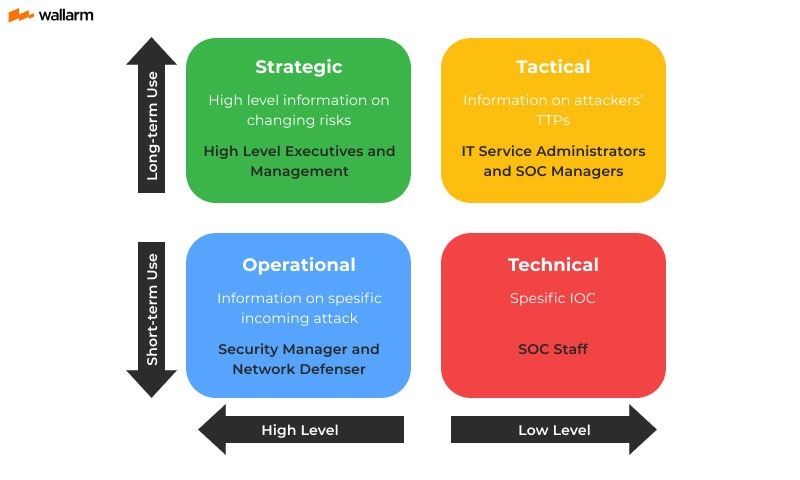
There are four main types of threat intelligence, each with its own unique features in how it combats threats and attacks. Each also plays a complementary role in the overall protection and management of the risks your business may face.
The four threat intelligence categories include:
- Strategic Threat Intelligence. This provides a high-level view of the threat landscape, helping to understand how threats evolve over time. Strategic threat intelligence summarizes potential attacks and consequences and is extremely valuable to stakeholders. The key focus of strategic threat intelligence is how threats can affect a specific organization/industry at a high level. The strategic approach is based on an analysis of emerging global trends and risks, which is then presented in a white paper or report.
- Tactical Threat Intelligence. Tactical intelligence focuses on tactics, techniques, and procedures (TTPs), and Indicators of Compromise (IOCs) needed to build a defense plan. This type of intelligence provides information on attacker methods and how best to mitigate them, which is especially valuable for IT and data security teams.
- Technical Threat Intelligence. Technical intelligence also takes into account Indicators of Compromise (IoCs). These threat indicators include reconnaissance actions, weaponization of vulnerabilities, and attack vectors. This makes technical intelligence effective against social engineering attacks. Moreover, this approach is highly adaptive, enabling quick adjustments once attackers change their tactics or discover new attack opportunities.
- Operational Threat Intelligence. Operational intelligence considers security information from various internal and external sources, including social media, historical events, chat rooms, antivirus logs, and more. This approach to security enables the prediction of the timing and nature of future cyberattacks. Operational intelligence can be enhanced with machine learning and data mining to automatically process multiple threat data points, including those in different languages. This type of intelligence is valuable for incident response and security teams, helping them make necessary adjustments, configure security controls, establish firewall rules, and set incident detection policies. This way, operational intelligence significantly reduces response times, which is especially important for security operations centers.
<H2> Threat Intelligence Lifecycle
(Інфографіка такого типу, але адаптувати під наш текст (Requirements / Data Collection / Data Processing / Analysis / Distribution / Feedback)
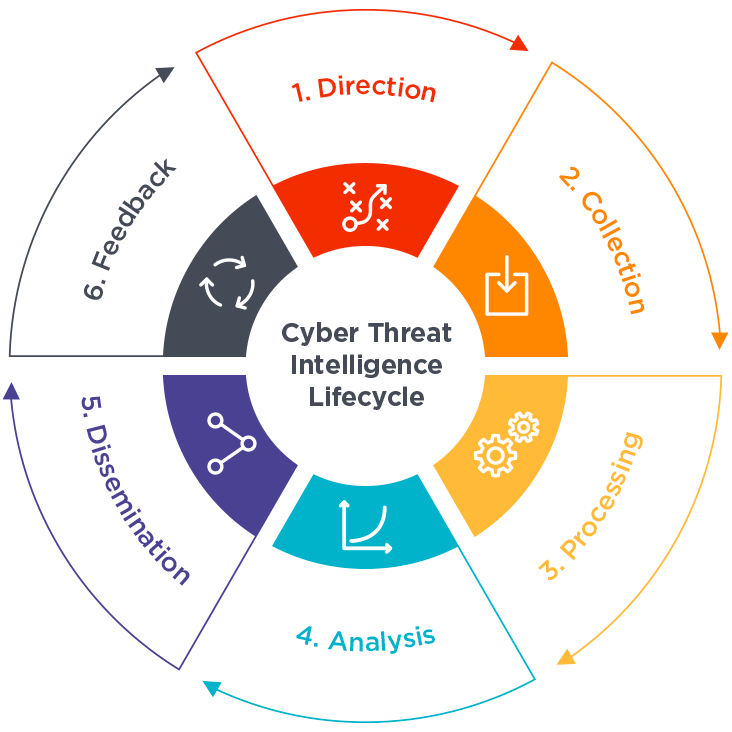
The threat intelligence lifecycle is a framework that enables the transformation of raw security data into actionable insights. This helps organizations optimize resources and create incident response plans for both new and known threats. The lifecycle includes six main stages: requirements, data collection, data processing, analysis, distribution, and feedback. Let’s take a closer look:
<H3> Requirements
This is about how the organization plans to use threat intelligence. A key step in the planning stage, defining requirements focuses on the following aspects:
- Who are the potential attackers?
- What is the attack surface, and which areas are most vulnerable?
- How can the organization mitigate and prevent threats, and what measures will help protect against future attacks?
<H3> Data Collection
Once the requirements are defined, the security team begins collecting data based on the stated objectives. Information is collected through public data sources, traffic logs, forums, social platforms, and other available channels.
<H3> Data Processing
Raw data is not enough for action. The next step is processing the collected data. This includes breaking it down into suitable formats for analysis. The process typically comprises data arrangement, translation (from different formats/sources), decryption, and assessment of data relevance and credibility.
<H3> Analysis
Analysis takes into account concerns raised during the requirements step. At this stage, the security team deciphers the processed threat intelligence data into actionable items and recommendations.
<H3> Distribution
Distribution is the translation of analysis into readable formats for presentation to stakeholders. Most often, observations, conclusions, and recommendations are presented in concise, plain language to simplify the task and ensure stakeholders fully understand the information.
<H3> Feedback
The final stage of the lifecycle is feedback, when the team incorporates stakeholder input and begins implementing a threat intelligence program based on the collected data, its analysis, and stakeholder decisions.
<H2> What is Threat Intelligence Integration?
Threat intelligence integrations involve combining data from various sources into a security information and event management (SIEM) system to effectively identify, assess, and respond to security threats and critical exposures.
<H2> The Importance of Integrating Threat Intelligence into Development and Product Planning
The key benefits of cyber threat intelligence integrations are that organizations can better secure their infrastructure and assets by gaining insights into the enemy’s tactics.
Furthermore, such integrations and threat intelligence platforms are extremely valuable during the development and planning stages, helping strengthen both tactical defense and strategic decision-making, as the benefits of integration extend well beyond just threat intelligence feeds.
For enterprises, threat intelligence integrations are important because they offer:
- Robust Security Measures. By understanding the specifics of potential threats, developers can build more secure systems from the start, fixing vulnerabilities before they are exploited.
- Proactive Threat Mitigation. An integrated threat intelligence platform enables proactive threat mitigation rather than reactive incident response. This helps anticipate threats before they become problematic.
- Reduced Development & Operational Risks. Threat intelligence allows for the identification and mitigation of risks during the development phase, significantly reducing the risk of security issues post-deployment.
- Enhanced Situational Awareness. Threat intelligence provides real-time context on threat actor motivations and global threat trends relevant to the enterprise’s sector.
- Regulatory Compliance. Integrating threat intelligence into the planning and development stages enables the development of an intelligence-driven defense posture that takes into account data protection requirements and regulations.
<H2> Integrating Threat Intelligence in the Software Development Lifecycle (SDLC)
Let’s look at how threat intelligence integrates into the secure software development lifecycle across its stages: planning, development, testing, and deployment.
<H3> Planning
We can highlight three main aspects worth focusing on: security objectives, potential threat identification, and resource allocation. It’s essential that your objectives align with the overall security strategy and address the project’s specific risks, ensuring security is a priority throughout the development process. Also, identifying potential threats early (by considering historical data, industry trends, and threat intelligence reports) enables the design of systems that are resilient to specific attack vectors. Finally, it’s essential to invest in threat intelligence platforms and staff training to ensure continuous monitoring and timely response to emerging threats, as well as to integrate threat data into the development lifecycle.
<H3> Development
During this stage, organizations can incorporate threat intelligence into coding practices to strengthen the application’s security posture. Plus, it helps make code less susceptible to known exploits. This methodology also adheres to secure coding standards to minimize risks and avoid the use of deprecated functions. Additionally, threat modeling and risk assessment help identify potential threats and the ways attackers can exploit vulnerabilities, including their likelihood and impact.
<H3> Testing
Penetration testing is among the best ways to identify security weaknesses, as it simulates real-world attacks. Integrating threat intelligence enhances penetration testing by providing up-to-date information on the latest threats and attack techniques, and by helping uncover vulnerabilities. It also enables continuous vulnerability assessment and test case creation through a deeper understanding of the unique threat landscape an organization may face.
<H3> Deployment
During the deployment phase, integrating threat intelligence into continuous monitoring and logging enables real-time identification and response to threats. This also helps the team regularly update the application and release patches, keeping them informed about the latest threats. Finally, threat intelligence provides context about the threat, potential impact, and remediation steps, enabling the creation of effective incident response and remediation strategies.
Threat intelligence has various use cases. For example:
- Many existing security tools used by security operations centers and incident response teams are generic, lacking sufficient correlation between network data and threat understanding. They can also provide a dump of information due to thousands of threat indicators. Threat intelligence helps speed up incident response by enriching tips and alerts with threat intelligence data, addressing these issues.
- Another problem is that detection tools may handle only limited amounts of data, requiring constant reprioritization of indicators. Threat intelligence integration provides proactive monitoring with playbook-driven automation (which contains filters and conditions that execute different branches depending on specific values).
- Another example is when an organization lacks sufficient understanding of attack details and how it may be vulnerable. Here, threat modeling is effective in preventing or mitigating the impact of threats on the system. Threat intelligence enables the identification of techniques and tools used by threat actors and the sharing of this information with key stakeholders.
<H2> Best Practices for Effective Threat Intelligence Integration
Organizations can employ various threat intelligence practices, the most common of which are:
- Continuous monitoring and vulnerability scanning
- Creating incident response plans
- Proactive threat hunting activities
- Intelligence data sharing and collaboration
- Threat intelligence feeds integration into the security infrastructure
- Cyber threat intelligence training and education
- Automation of processes to streamline threat intelligence management
At the same time, it makes sense to distinguish three practices: continuous monitoring, proactive threat hunting, and intelligence sharing.
- Continuous Monitoring. This enables real-time threat detection and response by continuously scanning networks and systems for vulnerabilities, enabling proactive defense.
- Threat Hunting. This involves searching for threats and vulnerabilities within the organization’s environment to identify potential threats before they cause damage.
- Intelligence Sharing. This enables robust defense against various threats through collaboration with other organizations and participation in information-sharing networks. So, companies can identify broader trends and patterns and gain actionable insights into emerging threats.
<H2> Threat Intelligence Integration Challenges and Solutions
Threat intelligence challenges worth considering are:
- Resource Limitations. Integrating threat intelligence and implementing changes/new tools requires resources. Organizations can use free, open-source solutions and feeds and scale efforts as needed.
- Data Overload. Large volumes of multi-format data require robust analytics and automation tools to process and prioritize information. A solution may be implementing a SIEM system and an automation platform (SOAR) to process only critical data.
- Source Reliability. Outdated or incorrect information leads to poor decision-making. Organizations should use commercial feeds and ISACs, regularly audit sources, and enable automated data validation across multiple independent sources.
- Integration Complexity. Integrating threat intelligence into existing systems/tools requires planning and seamless collaboration. The solution is standardized data exchange formats (STIX/TAXII) and APIs to connect to the existing infrastructure.
<H2> Integrating Threat Intelligence with Jappware’s Expertise
With Jappware, you can gain a comprehensive overview of your threat landscape. By developing custom solutions for organizations across industries such as finance, banking, healthcare, logistics, e-commerce, insurance, and legaltech, our team has the expertise and deep understanding of the unique threat landscape specific to your niche.
By starting projects and integrating threat intelligence into your existing systems with Jappware, you receive tailored solutions that address your objectives, needs, and industry specifics. Take advantage of our expertise to:
- Enhance your detection and response capabilities through security operations solutions to match real-time events and behaviors to attack patterns
- Detect vulnerabilities within your environment with threat hunting
- Expand incident response capabilities and ensure effective security controls through adversary TTPs
- Identify and prioritize security gaps, accounting for tactics and techniques not fully covered by existing defenses
- Design and assess security architectures through threat intelligence frameworks
- Determine the scope of an intrusion and implement effective remediation plans
- Get insights into tactics and procedures from clear threat reports
- Conduct staff training and education through our guilds
- Conduct risk assessments, develop security strategies, and monitor potential vulnerabilities
<H2> Summary
In addition to known vulnerabilities that are frequently exploited, malicious actors are constantly seeking new attack opportunities. As cyber threats emerge, securing infrastructure and assets is critical for organizations.
Threat intelligence provides an in-depth understanding of how hackers attack and of your organization’s attack surface. Implementing threat intelligence strengthens your security posture by enabling early threat detection, robust incident response, and informed decision-making, ensuring proactive defense, expanded visibility, and preventing breaches.
Threat Intelligence Integration: Best Practices Guide – Jappware
Discover best practices for threat intelligence integration. Learn how to strengthen security, streamline workflows, and protect your ecosystem.