Learn more about cloud infrastructure misconfigurations in AWS, GCP, and Azure. In this guide, we’ll look closer at causes of cloud misconfiguration, how they can be identified, and what organizations should do to prevent cloud misconfigurations.
<H2> What Is a Cloud Security Misconfiguration?
Cloud misconfiguration refers to glitches, human errors, security issues, and bugs that can expose the environment to cyber risk during cloud adoption. These risks most often include issues that may lead to data breaches, external hacks, insider threats, ransomware, etc. In other words, cloud misconfigurations can be defined as security vulnerabilities that go unnoticed, ignored, or are not correctly configured. Similarly, a leading vulnerability in a cloud environment is called cloud misconfiguration.
The reason for these problems is that misconfigurations in cloud computing can arise in multi-cloud environments due to the system’s complexity and numerous interrelated parameters. Worst of all, in this scenario, it can be difficult to detect and remediate mistakes across the entire cloud infrastructure, making misconfigurations a major headache for cloud service providers and the organizations using their infrastructure.
According to an IDC survey, security misconfiguration (67%), lack of adequate visibility into access settings and activities (64%), and identity and access management (IAM) permission errors (61%) were the top concerns associated with cloud production environments.
At the same time, a DevSecOps approach and proper cloud security posture management can significantly minimize risks by implementing security procedures at the build stage and conducting thorough vulnerability assessments at all stages of development.
<H2> Common Causes of Security Misconfiguration?
Cloud misconfigurations occur at various levels within the infrastructure. These can include:
- Operating system
- Databases
- Web servers
- Network devices
- Cloud applications
The most common types of cloud misconfigurations are weak/default passwords, unpatched/outdated software, improper/unrestricted access controls, open network ports, missing security patches, as well as incorrect file or directory permissions.
Examples of security misconfigurations can include situations where organizations set weak passwords for administrative accounts, grant excessive permissions to users, or fail to install security patches in a timely manner. Each of these issues can then lead to serious problems for the organization, such as unauthorized access, data breaches, being prone to known vulnerabilities that can become entry points for attackers, and so on.
Therefore, security teams must understand the types of cloud misconfigurations, the risks they pose, and the security measures they must implement to minimize potential security incidents.
*CTA* Spot & Resolve Cloud Misconfigurations. Cooperate With Jappware And Secure Your Cloud Infrastructure
<H2> The 10 Most Common Cloud Misconfigurations
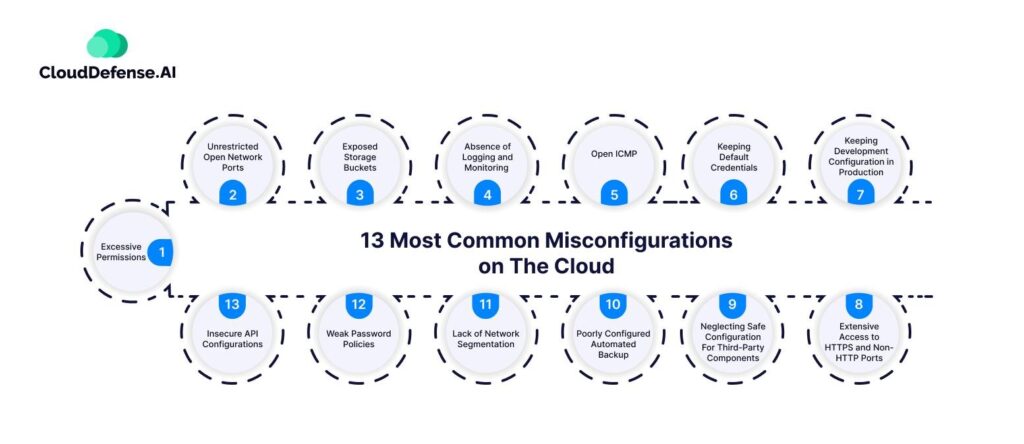
Being aware of cloud misconfiguration is the first step to protecting your environment. Here are the 10 most common issues that can arise with cloud configurations:
(Додати інфографіку такого типу, адаптувати під наші 10 common cloud misconfiguration)
<H3> 1. Publicly Accessible Storage
Publicly accessible storage buckets are among the most common. If they are not properly configured, an attacker with the right URL can gain access to sensitive data without authentication. It is important to implement strong access controls and malware signature scanning to ensure cloud security.
<H3> 2. Over-Permissive IAM Roles
When least-privilege principles are absent and role policy audits are ignored, organizations may encounter overly-permissive access. This cloud misconfiguration allows actors to escalate privileges, thereby modifying roles and gaining administrative rights in an AWS account.
<H3> 3. Disabled Logging and Monitoring
Another cloud security misconfiguration is disabled monitoring and logging. If audit logs, access logs, or network flow logs are misconfigured or turned off, visibility into cloud activity disappears, making it difficult to detect attacks and investigate security breaches, as the attacker can operate undetected for extended periods.
<H3> 4. Weak or Missing MFA
Implementing Multi-Factor Authentication (MFA) for all privileged accounts is critical to a security posture, as it minimizes the risk of unauthorized access, which is especially important for high-privilege roles. Weak or absent MFA can give an attacker complete control over the cloud environment, leading to unauthorized configuration changes, data theft, and infrastructure compromise.
<H3> 5. Insecure API Endpoints
Lack of authentication or security validation in API endpoints significantly increases the risk of unauthorized access to sensitive systems. Therefore, it is essential to use discovery tools to detect misconfigured or shadow APIs and enforce access policies (restrict access in the case of public APIs unless it is necessary).
<H3> 6. Unencrypted Data
The lack of encryption in storage buckets, as well as the lack of TLS/SSL for API traffic, makes data vulnerable while at rest and in transit, which can lead to interception and unauthorized access, and is among the most common causes of data security breaches.
<H3> 7. Unrestricted Security Groups
Misconfigurations in network security groups may lead to a risk of allowing access from any IP address, which makes brute force and botnet attacks possible, exposing resources through overly permissive security groups.
<H3> 8. Misconfigured Kubernetes Clusters
Poorly configured and rarely monitored Kubernetes clusters can cause serious problems for organizations. Simplifying the management of applications across different environments, Kubernetes is extremely common, but if cluster issues go undetected, companies risk downtime, security breaches, data loss, and scaling issues.
<H3> 9. Default Credentials
Default credentials are often weak and widely known, making them extremely attractive to attackers because they simplify the process of gaining access. Therefore, when it comes to access management, all default passwords and credentials must be changed from the very beginning.
<H3> 10. Overexposed Backups and Snapshots
Backups and snapshots may not receive sufficient attention in cloud security. This may include legacy storage accounts, unused containers, forgotten disaster recovery buckets, and so on. Worse, overexposed backups may contain sensitive data that attackers can access without needing to break in. Furthermore, botnets and scanners scan cloud environments nonstop, so if backups expose sensitive information, it will be found.
<H2> How to Detect Misconfigurations Before Attackers Do
Organizations can detect cloud misconfigurations using various tools and approaches. The most effective methods are:
<H3> Cloud Security Posture Management (CSPM)
CSPM offers real-time monitoring and detailed assessment of cloud environments, identifying misconfigurations and compliance violations. Organizations typically use automated tools that perform security checks, provide real-time alerts, and help fix security issues. CSPM is a way to thoroughly scan cloud infrastructure, including storage buckets or an IAM policy, for any unnecessary permissions.
<H3> Security Information and Event Management (SIEM)
Another type is SIEM tools. These solutions allow you to collect and analyze data from logs and events for a cloud environment, thereby ensuring event correlation within and across systems. This helps effectively detect security incidents and identify possible misconfigurations.
<H3> Vulnerability Scanners and Penetration Testing Tools
Scanners and pentesting tools are the best way to discover vulnerabilities that can result from various misconfigurations. Most importantly, this approach enables the detection of vulnerabilities that were previously overlooked by developers and security teams. By recognizing open ports, deficient encryption, and outdated software, as well as simulating real-world attacks, scanners and penetrating tools enable the identification of system weaknesses caused by misconfigurations.
<H2> How to Fix and Prevent Misconfigurations
These cloud misconfiguration fixes and preventative tactics are among the best options to minimize cloud security risks:
- Publicly Accessible Storage — disable public access to cloud storage and configure IAM/ACLs for key users. Applying “deny public” by default, and using scanners can prevent such security problems.
- Over-Permissive IAM Roles — implement the least privilege principle and remove *:* permissions. Using role-based access controls and periodic permission audits is the best prevention tactic.
- Disabled Logging and Monitoring — be sure to enable logging and configure alerts for any suspicious/anomalous events. A SIEM approach and continuous monitoring, as well as logging in baseline configurations, minimize risks.
- Weak or Missing MFA — the obvious fix is to enable MFA for all users, especially key accounts. Additionally, organizations should implement policies requiring MFA and use Single Sign-On (SSO) with MFA as a preventative measure.
- Insecure API Endpoints — add OAuth and API keys authentication, restrict access by IP, and ensure HTTPS protocol. Regular security testing and API gateway implementation are effective in preventing endpoint-related risks.
- Unencrypted Data — organizations should use strong encryption algorithms and enable them for data during both rest and transit. Enabling encryption by default and enforcing policies prohibiting unencrypted resources are among the best practices.
- Unrestricted Security Groups — restrict access by IP and port, and use secure security group templates and automatic configuration checks.
- Misconfigured Kubernetes Clusters — this issue can be fixed by configuring role-based access control, removing privileged containers, and disabling public access to the API server. To prevent this, run regular security scans and use managed Kubernetes (EKS/GKE/AKS).
- Default Credentials — Use vaults and change all default credentials. Implement automatic secret rotation and a no-deploy policy for default credentials.
- Overexposed Backups and Snapshots – Keep your backups private, and restrict access via IAM. Implementing encryption, accessibility audits, and snapshot access policies are effective preventative measures.
<H2> Cloud Misconfiguration Examples by Service
Here are the most common cloud misconfigurations among different cloud providers:
| Type | Azure | AWS | GCP |
| Databases | Not enforcing SSL, and no retention period set. Publicly accessible database | No data encryption, table backup exists | Lack of SSL, SQL contained database authentication and publically accessible database |
| Networking | IP forwarding and public ingress & egress in network security groups enabled. Public IP on virtual machine | IP forwarding and public ingress & egress in network security groups enabled. Public IP enabled on EC2 | IP forwarding and public ingress & egress in network security groups enabled. Public IP on Compute Engine |
| Serverless | No encryption policies for database, hosting a website with vulnerabilities, not configured WAF | Out-of-date runtime environments, lack of encryption, Lambda Functions are accessible globally | Cloud Function Serverless Global Access, HTTP instead HTTPS. Ingress all traffic enabled |
| Access Management | Azure AD directory access, guest users in Azure AD, and mismanaged roles | Over-permissive IAM roles & customer-based inline policies. Usage of Root user | No user granted permissions; Service account user/service account role/service account admin |
| Virtual Environment | Custom ports enabled. VM AD authentication disabled. No limits in VM instances | Custom ports enabled. No limits on OnDemand vCPU instances. Instance IAM role limitless access | Custom ports enabled. VM Instance is over permissive. No limit on VM instances creation |
<H2> How Continuous Posture Management Solves the Problem
Continuous posture management is essentially a combination of practices and tools that perform a number of tasks. This includes continuous scanning, cloud resource auditing (e.g., S3, IAM, networks, Kubernetes), auto detection, and configuration correlation with standards (CIS, NIST).
This approach enables the identification of vulnerabilities and the receipt of alerts in real time. This allows the security team to respond and conduct remediation before hackers can exploit them.
Collaborating with a developer is the best way to implement a security posture across the entire environment. By working with Jappware specialists, you can benefit from:
- Custom security policies tailored to the specifics of your operations
- CI/CD integration to ensure issues don’t reach production
- Unified security pipeline (CSPM + SIEM + IAM + DevSecOps approach)
- Automatic misconfiguration remediation
- Risk prioritization based on the immediate threat to your system
<H2> Best Practices and Policy Guardrail
Security controls such as Cloud Guardrails are among the most effective practices, ensuring proper configuration and preventing errors. There are three types of guardrails:
(Інфографіка такого типу)
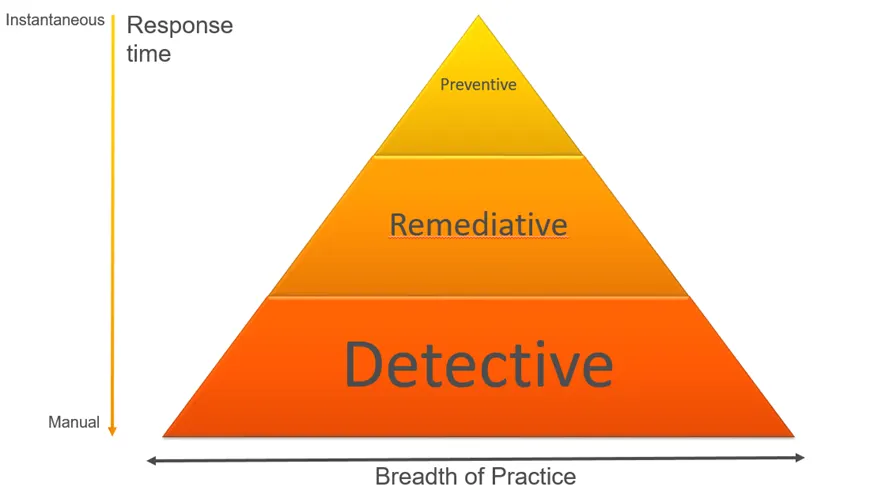
- Preventive Guardrails help avoid problems by blocking actions before a resource is created. These guardrails are implemented in CI/CD, IAM policies, and SCP (Service Control Policies), preventing the creation of public storage, unencrypted deployments, lack of MFA, and more.
- Detective Guardrails is for when a problem already exists. This approach provides cloud infrastructure scanning to identify misconfigurations and a system of alerts so the security team can quickly respond to vulnerabilities.
- Remediative Guardrails are about automatically fixing misconfigurations. These guardrails are triggered when an event occurs, after receiving an alert. This allows you to enable encryption if it wasn’t already in place, remove unnecessary privileges, close public access, and so on to minimize damage.
<H2> Summary
Cloud misconfigurations can arise for a number of reasons, especially when dealing with multiple cloud providers and environments. The increased flexibility and scalability afforded by cloud solutions open up more room for potential vulnerabilities and misconfigurations, making systems and data vulnerable to attacks.
Organizations often encounter similar misconfigurations. The good news is that they can be avoided and remedied. Collaborating with developers on custom solutions and implementing continuous posture management allows for a timely response to incidents and vulnerabilities, and most importantly, prevents them from occurring.
Learn more about how to secure your cloud infrastructure while maintaining its flexibility and scalability by contacting Jappware.
Top 10 Common Cloud Security Misconfigurations – Jappware
Explore the top 10 cloud security misconfigurations, their causes, detection methods, and fixes to keep your cloud data secure and compliant.